New technology
3D printing and additive manufacturing: occupational hazards and a control hierarchy
What NIOSH has published on additive manufacturing hazards — powders, VOCs, ultrafine particles and other risks — and why a written risk-management plan should start with substitution and engineering controls, not PPE alone.

Additive manufacturing, also called 3D printing, is a set of technologies that assemble objects from smaller pieces of material. The National Institute for Occupational Safety and Health (NIOSH) gives fused filament fabrication, vat polymerization and powder bed fusion as examples. The technologies are no longer limited to prototyping: NIOSH notes that they are becoming less expensive and are used in production, and that they affect the automotive, aerospace, electronics, medical and consumer markets.1
Use is also no longer limited to factories. NIOSH lists laboratories, factories, hospitals, schools, libraries and homes. A July 2024 NIOSH science bulletin adds that makerspaces, schools, libraries and small businesses mostly use two kinds of 3D printers: fused filament fabrication, which melts a thermoplastic filament and deposits it with a moving extruder, and vat polymerization, which uses ultraviolet light from a laser or projector to cure photopolymer resin.12
Hazards vary with the technology, the materials and the environment. NIOSH’s overview lists inhalation of materials used in powdered form and of volatile organic compounds (VOCs) emitted during printing; dermal exposure to powdered and liquid hazardous materials; fire or explosion from flammable or combustible substances; and mechanical or ergonomic injury from machine support and maintenance, loading and handling of build materials, and handling of products.1
Criteria that should lead the work
- Have you identified the process actually in use — filament, resin or powder — and the stages around it, including pre-printing, printing, post-processing, maintenance and cleaning?
- Is there a written risk-management plan that describes those activities and follows the hierarchy of controls, rather than starting with a box of gloves?
- Can a less hazardous material or process be substituted before you rely on ventilation or personal protective equipment?
- Are engineering controls such as ventilation and high-efficiency particulate air filtration considered at the source?
- Is personal protective equipment treated as a last resort, selected for the hazards that remain?
What official research has already shown
NIOSH states that laboratory studies have indicated three points that should influence how desktop filament printers are set up: fused filament fabrication desktop printers emit respiratory irritants; filament material and coloration significantly affect VOC emission rates; and printing with nanomaterial-containing filaments leads to emission of nanomaterial-containing particulate matter.1 Those findings do not tell you the emission rate of a particular printer in your room, but they do warn against treating “just plastic filament” as a harmless office appliance, and against assuming that a change of colour is only a cosmetic choice.
The 2024 bulletin describes a wider set of health and safety concerns from NIOSH evaluations of emissions in laboratory and workplace settings. They include potential exposure to ultrafine particles (particles smaller than 100 nanometres) and chemicals; solvents that may be flammable, create hazardous or explosive vapours, cause eye or respiratory irritation, or potentially cause cancer; burns from hot surfaces; moving parts that can trap hair, fingers and clothing; lasers that might become unguarded during maintenance; electrical hazards during maintenance, malfunction or improper use; noise, particularly when several printers are used in a single room; collision with automated robotic assistance if it is used; and take-home exposures, which can expose family members, especially by home-business users.2 Hazards may occur during pre-printing, printing, post-printing, and maintenance and cleaning, not only while the build is running.
| Criterion | Open-bench use with no dedicated plan | Personal protective equipment as the main control | Written plan with substitution and engineering controls first |
|---|---|---|---|
| Coverage of process stages | Usually limited to the print cycle | Often still limited to the print cycle | Pre-printing, printing, post-processing, maintenance and cleaning |
| Substitution of less hazardous materials or processes | Rarely considered | Easy to skip if a mask is available | Priority near the top of the hierarchy of controls |
| Source control (ventilation, filtration, enclosure features) | A printer on an open desk | Secondary to gloves and a respirator | Engineering controls such as proper ventilation and HEPA filtration, including optional printer features |
| Role of PPE | Ad hoc, or absent | Treated as the main barrier | Last resort, selected for residual hazards (for example eye protection, chemical and thermal-resistant gloves, respiratory protection) |
| Main failure mode | Emissions, heat and moving parts treated as an office inconvenience | PPE used instead of changing the material, the enclosure or the ventilation | A plan that exists on paper but is not used in a school, library or small workshop |
A plan that follows the hierarchy of controls
In 2023, NIOSH published Approaches to Safe 3D Printing: A Guide for Makerspace Users, Schools, Libraries, and Small Businesses. The science bulletin, which we verified, states that employers and managers in those settings should write a comprehensive risk-management plan for 3D printing. The plan should describe the hazards related to each of the work activities and provide best practices and standard operating procedures that follow the hierarchy of controls: elimination, substitution, engineering controls, administrative controls, and personal protective equipment.2 This article relies on the official bulletin for that summary; it does not quote page-level detail from the guide itself.
The bulletin’s examples are consistent with that order. Focus on strategies near the top of the hierarchy, such as eliminating or substituting the hazard — especially where users have differing levels of experience, as in schools, libraries, makerspaces and small businesses. Use engineering controls such as proper ventilation and high-efficiency particulate air filters for source control; some printers have optional features or modifications to better control emissions. Administrative controls include plans, policies and encouraging safe behaviours, and their effectiveness depends on employer commitment and user acceptance. Personal protective equipment is a last resort because it is the least effective control.2

An enclosure around filament is only one kind of engineering control, and only if it is actually used and maintained. NIOSH also notes that it has carried out field exposure assessments at additive-manufacturing sites and that it continues laboratory and field studies. It is developing a series of additive-manufacturing health and safety videos, beginning with an introduction covering common hazards, control strategies and current NIOSH resources. That introduction film is described on the official overview; it is not the video embedded below.1
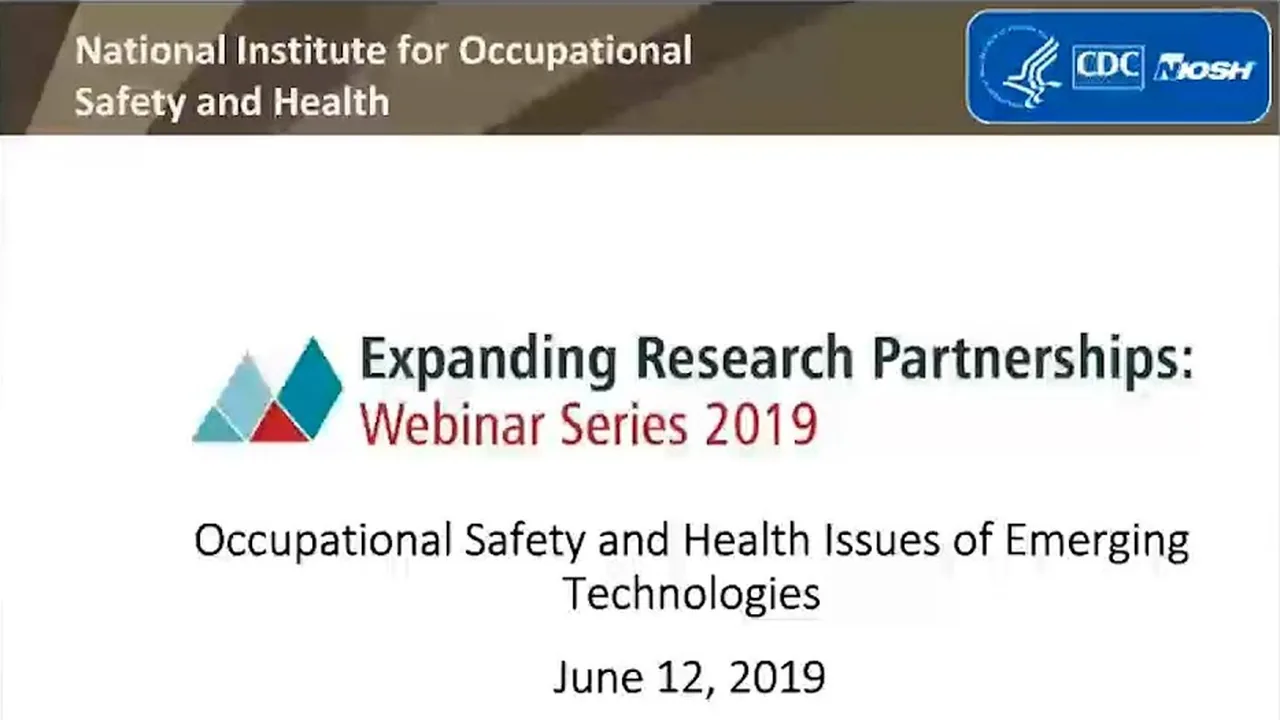
The official CDC film “Safety and Health Issues of Emerging Technologies at Work” is a 2019 NIOSH webinar on occupational safety and health issues of emerging technologies. It is not a demonstration of 3D-printer software, and it is not the NIOSH additive-manufacturing introduction film mentioned on the overview page. Use it as official context for emerging-technology risk at work, alongside the NIOSH pages cited here.
For practice on inventories and safety data sheets for process materials, see Chemical Inventory & SDS Lifecycle Management. Assessment practice is also covered in Risk Assessment & Job Hazard Analysis. These are independent awareness and exam-preparation courses. They are not official IRCA, ISO, NEBOSH or IOSH awards, and they are not a substitute for a licensed standard or for legal compliance.
A practical way to decide
Name the process and the materials, including any nanomaterial-containing filament or resin, and map the stages around the printer, not only the build. Write a plan that starts with substitution and engineering controls. Treat ventilation, filtration and enclosure features as source controls, and keep PPE for residual risk. Review the plan when the machine, the material or the people using it change, including in classrooms, libraries and home-based businesses where take-home exposure may also matter.12
Do not treat a desktop printer as automatically low-risk because it is small, and do not use a respirator or a pair of gloves as a reason to skip ventilation or a less hazardous material.
Frequently asked questions
Where does NIOSH say additive manufacturing is used?
NIOSH lists laboratories, factories, hospitals, schools, libraries and homes. The 2024 science bulletin adds that makerspaces, schools, libraries and small businesses mostly use fused filament fabrication and vat polymerization.
What have NIOSH laboratory studies indicated about desktop FFF printers?
On its official additive-manufacturing overview, NIOSH states that laboratory studies have indicated that fused filament fabrication desktop printers emit respiratory irritants; that filament material and coloration significantly affect volatile organic compound emission rates; and that printing with nanomaterial-containing filaments leads to emission of nanomaterial-containing particulate matter.
Does NIOSH treat personal protective equipment as the main control?
No. The 2024 NIOSH science bulletin states that the hierarchy of controls prioritises elimination, substitution, engineering controls, administrative controls and personal protective equipment, and that PPE should be used as a last resort because it is the least effective control. Examples of PPE it mentions include eye protection, chemical and thermal-resistant gloves, and respiratory protection.
Sources
Every factual statement marked with a number links to the source below. Sources were retrieved on 22 November 2026; check the publisher for later revisions.